


Retatrutide Clinical Results Mechanism & Access Guide
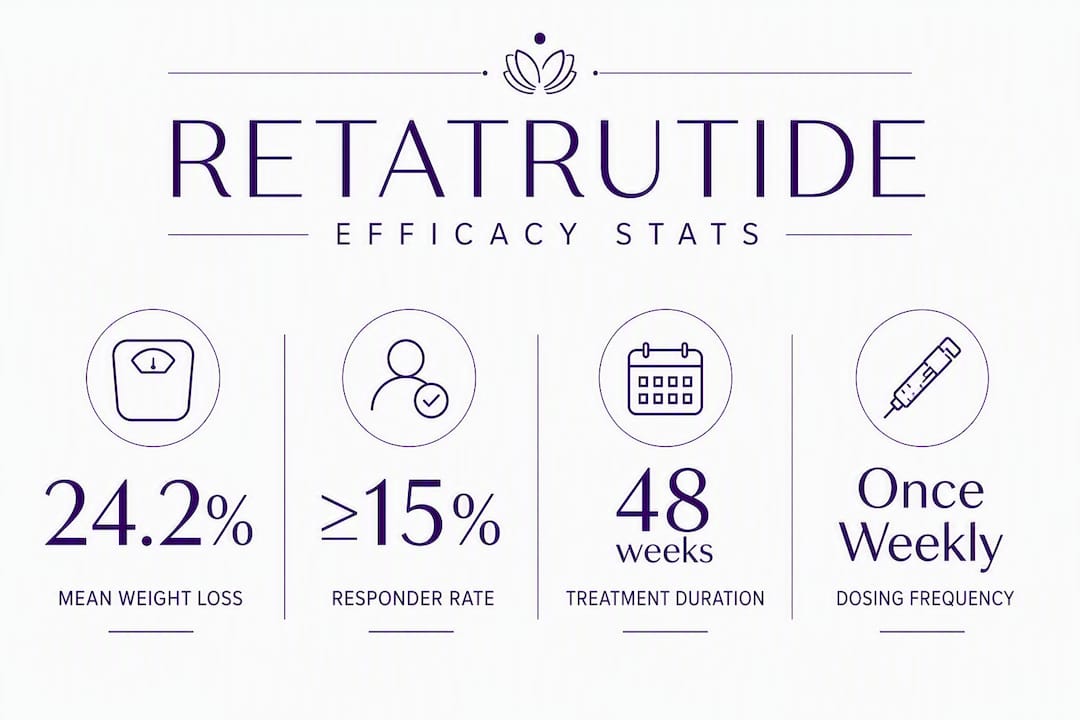
Retatrutide is an investigational, once-weekly subcutaneous injection developed by Eli Lilly that simultaneously activates three hormone receptors: GIP, GLP-1, and glucagon. In the pivotal phase 2 randomized controlled trial published in the New England Journal of Medicine, participants receiving the highest dose (12 mg) lost a mean of 24.2% of body weight at 48 weeks, with up to 83% of participants in that group achieving at least 15% weight loss. Those numbers are larger than anything previously reported for a pharmacological obesity treatment in a controlled trial of similar duration.
The drug is not FDA-approved. Access is limited to clinical trials. Phase 3 programs (TRIUMPH for obesity and TRANSCEND for type 2 diabetes and related conditions) are underway, with the TRANSCEND-T2D-1 trial now published as a phase 3 randomized trial. Until a full regulatory submission and FDA review are complete, retatrutide remains investigational.
Key facts at a glance:
- Mechanism: Triple agonist at GIP, GLP-1, and glucagon receptors in a single synthetic peptide
- Headline efficacy: Mean body-weight loss of about 24% was observed at 48 weeks with the highest dose in phase 2
- Responder rate: A large proportion of participants at the highest dose achieved substantial weight loss
- Dosing: Once-weekly subcutaneous injection, enabled by a 6-day half-life
- Status: Investigational only; phase 3 trials ongoing; no FDA approval as of 2026
- Primary side effects: Gastrointestinal (nausea, vomiting, diarrhea, constipation), dose-related
- Access: Clinical trials only; illicit online products carry serious contamination and dosing risks
Table of Contents
- How does retatrutide work at the receptor level?
- What do the clinical trials show?
- What are the side effects of retatrutide?
- How is retatrutide dosed?
- What conditions is retatrutide being studied for?
- How does retatrutide compare with semaglutide and tirzepatide?
- How can you access retatrutide right now?
- Why the glucagon receptor may be the most important piece
- Key Takeaways
- The evidence is real, but the hype is running ahead of it
- Useful sources and further reading
How does retatrutide work at the receptor level?
Retatrutide is a single unimolecular peptide engineered to engage all three targets simultaneously. That distinction matters because prior obesity drugs either targeted one receptor (GLP-1 agonists like semaglutide) or two (dual GIP/GLP-1 agonists like tirzepatide). Adding glucagon receptor activation is the structural choice that separates retatrutide from both.
Each receptor contributes a distinct physiological effect:
- GLP-1 receptor: — Reduces appetite and food intake, stimulates glucose-dependent insulin secretion, slows gastric emptying
The glucagon axis is the most clinically novel piece. GLP-1–only agents reduce caloric intake effectively, but the body often compensates by reducing energy expenditure during sustained weight loss. Glucagon receptor activation is designed to counteract that adaptation, which is why researchers expected retatrutide to produce greater fat loss relative to lean mass loss compared with single-agonist therapies.
Potency profile: Retatrutide is not equally active at all three receptors. Manufacturer pharmacology data show it is approximately 8.9-fold more potent at the human GIP receptor than endogenous GIP, while it is 0.3–0.4 times as active at the GLP-1 and glucagon receptors relative to their endogenous ligands. The high GIP potency is intentional: it allows meaningful GIP signaling at doses that keep GLP-1 and glucagon activity within a tolerable range.

Pharmacokinetics: The molecule includes a C20 fatty diacid moiety that promotes albumin binding, extending its half-life to approximately 6 days. That structural modification is what makes once-weekly subcutaneous dosing feasible, mirroring the approach used in other long-acting incretin therapies.
What do the clinical trials show?
Phase 2 efficacy: the core numbers
The phase 2 trial enrolled adults with obesity without type 2 diabetes. Participants were randomized to placebo or one of several retatrutide dose groups and followed for 48 weeks, with all groups receiving lifestyle counseling alongside the drug.

| Dose group | Mean % weight loss at 48 weeks | ≥15% weight-loss responder rate |
|---|---|---|
| Placebo | — | Not reported |
| 1 mg | — | Not reported |
| 4 mg | — | Substantial minority |
| 8 mg | — | Majority |
| 12 mg | −24.2% | Up to 83% |
Source: NEJM phase 2 trial. Intermediate-dose figures are approximate from published data ranges.
Beyond weight, secondary outcomes at higher doses included meaningful reductions in waist circumference, fasting insulin, and triglycerides. The speed of weight loss was also notable: significant separation from placebo appeared within the first 4–8 weeks.
Phase 3 programs: TRIUMPH and TRANSCEND
The phase 3 program covers multiple populations and indications:
- TRIUMPH: Obesity and overweight with comorbidities (without T2D); primary endpoint is percent body-weight change
- TRANSCEND: Type 2 diabetes (glycemic control and weight); cardiovascular outcomes; MASLD; obstructive sleep apnea (OSA); knee osteoarthritis pain; chronic low back pain; renal outcomes
The TRANSCEND-T2D-1 trial, a double-blind phase 3 study in people with type 2 diabetes and inadequate glycemic control on diet and exercise alone, has been published. ClinicalTrials.gov lists multiple active TRIUMPH and TRANSCEND registrations with trial identifiers including NCT05929079, NCT05936151, NCT05931367, NCT06383390, and NCT07165028.
Limitations to keep in mind: Phase 2 populations were non-diabetic adults with obesity, so results may not translate directly to people with T2D or other metabolic comorbidities. Follow-up beyond 48 weeks is limited in published data. Full phase 3 datasets for most TRIUMPH arms are not yet peer-reviewed, and cross-trial comparisons with other agents carry inherent confounds (different populations, titration schemes, trial durations).
What are the side effects of retatrutide?
Gastrointestinal adverse events such as nausea, diarrhea, vomiting, and constipation were the most frequently reported side effects and were dose-related: higher doses produced more GI events, particularly during the dose-escalation phase. Slower titration schedules reduced the severity of these events without substantially compromising efficacy.
Key safety signals from trials:
- GI events: Nausea and diarrhea were most common; typically transient and most pronounced during escalation
- Heart rate: Transient, dose-dependent increases in resting heart rate were observed; these peaked during early treatment and partially declined over time
- Serious adverse events: Infrequent in the phase 2 trial; no signal of increased pancreatitis or major cardiovascular harm was identified in the non-diabetic population studied, though the trial was not powered or designed to detect rare events
- Long-term safety: Remains under investigation; phase 2 follow-up does not provide durability data beyond 48 weeks
Serious adverse events were rare in the phase 2 trial, but the absence of a signal in a 48-week study does not rule out risks that emerge over years of use. Long-term cardiovascular, renal, and oncologic safety will require the full phase 3 dataset.
Contraindications and precautions (align with incretin-class guidance):
- Medullary thyroid carcinoma or MEN2: Personal or family history is a precaution for all incretin-based therapies; retatrutide carries the same class-level concern pending specific long-term data.
- Prior pancreatitis: Use caution; pancreatitis history is a standard precaution for GLP-1–class agents.
- Pregnancy: Not studied; standard precaution applies.
Illicit products: Eli Lilly has explicitly warned that unregulated retatrutide products sold online may be contaminated, incorrectly dosed, or contain no active ingredient at all. Purchasing from non-trial sources is both legally risky and potentially dangerous.
How is retatrutide dosed?
Retatrutide is administered as a once-weekly subcutaneous injection, a dosing schedule made possible by its 6-day half-life from albumin binding. In the phase 2 trial, participants did not start at the target dose. Dose escalation was structured to reduce GI burden:
- Starting doses: Participants began at 2 mg or 4 mg depending on the assigned arm
- Escalation steps: Doses were stepped up at defined intervals (typically every 4 weeks) through intermediate doses (4 mg, 8 mg) to the target maintenance dose (up to 12 mg)
- Tolerability rationale: Lower starting doses and gradual escalation reduced the frequency and severity of nausea and vomiting during the adjustment period
Expected clinical administration (if approved):
- Self-injection with a prefilled pen device, similar to existing GLP-1 therapies
- Clinician supervision during initiation and each dose step, with monitoring of heart rate, metabolic labs (fasting glucose, lipids, liver enzymes), and body weight
- Ongoing monitoring for GI symptoms, with the option to hold or slow escalation if tolerability is poor
The trial protocol also included structured dietary counseling and physical activity guidance alongside the medication. Retatrutide was not studied as a standalone, unsupervised intervention, and the efficacy numbers reflect that combined approach.
What conditions is retatrutide being studied for?
The phase 3 program covers a broader set of indications than any prior obesity drug has pursued simultaneously:
- Obesity / overweight with comorbidity (TRIUMPH program, primary indication)
- Type 2 diabetes (TRANSCEND-T2D-1, published phase 3 data available)
- MASLD (metabolic dysfunction-associated steatotic liver disease, formerly NASH)
- Obstructive sleep apnea
- Knee osteoarthritis pain
- Chronic low back pain
- Cardiovascular outcomes
- Renal outcomes
Regulatory timeline for U.S. readers: Eli Lilly has stated that retatrutide is in phase 3 trials across multiple indications. The path from topline phase 3 data to FDA approval typically involves completing the full data package, submitting a New Drug Application (NDA), and undergoing an FDA review period (standard review: 10–12 months; priority review: 6 months). A conservative estimate for potential approval in the obesity indication, assuming positive phase 3 data and timely submission, would be 2026–2027 at the earliest, though this depends entirely on trial completion and regulatory outcomes. Watch FDA.gov and Eli Lilly’s investor relations pages for NDA filing announcements.
How does retatrutide compare with semaglutide and tirzepatide?
Cross-trial comparisons are imperfect by design. Different populations, titration schedules, and trial durations all affect the numbers. No head-to-head trial between retatrutide and either semaglutide or tirzepatide has been published. With that caveat stated, the mechanistic and efficacy differences are real and worth understanding.
| Feature | Single GLP-1 agonist (e.g., semaglutide) | Dual GIP/GLP-1 agonist (e.g., tirzepatide) | Triple agonist (retatrutide) |
|---|---|---|---|
| Receptor targets | GLP-1 | GIP + GLP-1 | GIP + GLP-1 + glucagon |
| Reported mean % weight loss (trials) | ~15–17% at 68 weeks (highest dose) | ~20–22% at 72 weeks (highest dose) | ~24% at 48 weeks (highest dose, phase 2) |
| Dosing route/frequency | Once-weekly subcutaneous | Once-weekly subcutaneous | Once-weekly subcutaneous |
| Common adverse events | Nausea, vomiting, diarrhea | Nausea, vomiting, diarrhea | Nausea, vomiting, diarrhea, constipation |
| Regulatory status | FDA-approved (obesity, T2D) | FDA-approved (obesity, T2D) | Investigational; phase 3 ongoing |
| Key mechanistic distinction | Appetite/satiety reduction | Appetite reduction + GIP insulinotropic effects | Appetite reduction + GIP effects + energy expenditure increase |
The glucagon receptor addition is the key mechanistic differentiator. GLP-1–only agents reduce caloric intake effectively but do not directly address the compensatory drop in energy expenditure that occurs during sustained weight loss. Tirzepatide adds GIP signaling, which appears to enhance efficacy over GLP-1 alone. Retatrutide adds glucagon on top of both, theoretically preserving or increasing resting energy expenditure during the weight-loss period. Whether that translates to meaningfully better long-term fat-mass outcomes compared with tirzepatide will require head-to-head data.
Caveat: The 24.2% figure for retatrutide comes from a 48-week phase 2 trial in a non-diabetic population. Semaglutide and tirzepatide numbers come from phase 3 trials of longer duration in larger, more diverse populations. The comparison is directionally informative, not definitive.
How can you access retatrutide right now?
Retatrutide is not commercially available. The only legitimate path to access is enrollment in a clinical trial. Here is what that process looks like in practice:
- Search ClinicalTrials.gov: — Use the search term “retatrutide” or the trial identifiers (NCT05929079, NCT05936151, NCT05931367, NCT06383390, NCT07165028) to find currently enrolling studies and their locations
Warning about online sources: Eli Lilly has been explicit: retatrutide products sold online outside of clinical trials are unregulated. Known risks include contamination, incorrect active ingredient content, and inconsistent dosing. There is no safe way to obtain retatrutide outside a sanctioned trial at this stage.
Pro Tip:If you are a clinician considering referring patients to a retatrutide trial, review the ClinicalTrials.gov eligibility criteria before the referral conversation. Patients with a history of medullary thyroid carcinoma, MEN2, or prior pancreatitis will not qualify, and setting that expectation early saves time and manages disappointment.
Why the glucagon receptor may be the most important piece
The glucagon axis is the part of retatrutide’s mechanism that most researchers find genuinely novel, and it is worth understanding why.
During sustained caloric restriction, the body reduces resting energy expenditure as a compensatory response. This is one reason people on GLP-1 therapies often plateau in weight loss after the first year: intake drops, but so does the metabolic rate. Glucagon receptor activation works against that adaptation by stimulating hepatic glucose production, promoting lipolysis in adipose tissue, and increasing thermogenesis. The unimolecular triple-agonist design specifically aims to preserve energy expenditure during weight loss, which is the mechanistic argument for why retatrutide might produce greater fat-mass loss relative to lean mass compared with GLP-1–only agents.
The liver-fat data support this hypothesis. In the Nature Medicine MASLD substudy, retatrutide produced dose-dependent reductions in liver fat at 24 weeks: from −42.9% relative reduction at 1 mg to −82.4% at 12 mg, compared with +0.3% for placebo. Normalization of liver fat (below 5%) occurred in 79–86% of participants at higher doses. Those are striking numbers for a 24-week intervention in a population with established hepatic steatosis.
Metabolic markers beyond weight:
- Fasting insulin and HOMA2-IR (a measure of insulin resistance) improved in a dose-dependent manner at higher doses
- Triglycerides fell significantly in MASLD substudies, consistent with reduced hepatic lipid synthesis and increased lipolysis
- Improvements in these markers correlated with both the degree of weight loss and the dose, suggesting direct metabolic effects beyond simple caloric reduction
Open questions: Whether these liver-fat reductions translate to histological improvement in NASH (now MASLD), reduced fibrosis, or long-term cardiovascular benefit remains to be established in phase 3. The durability of metabolic improvements beyond 48 weeks is also unknown. And the effects in people with type 2 diabetes, where glucagon dynamics are already dysregulated, will require careful interpretation of the TRANSCEND data.
Key Takeaways
Retatrutide is the most efficacious weight-loss drug reported in controlled trials to date, with a triple-receptor mechanism that distinguishes it from every currently approved obesity therapy, but it remains investigational and accessible only through clinical trials.
| Point | Details |
|---|---|
| Triple-receptor mechanism | Retatrutide activates GIP, GLP-1, and glucagon receptors simultaneously in a single synthetic peptide. |
| Phase 2 efficacy | The highest dose produced mean body-weight loss around 24% at 48 weeks, with up to 83% of participants achieving at least 15% weight loss. |
| Dominant side effects | Gastrointestinal events (nausea, vomiting, diarrhea) are dose-related and partially mitigated by slower dose escalation. |
| Regulatory status | Not FDA-approved; phase 3 TRIUMPH and TRANSCEND programs are ongoing as of 2026. |
| Safe access only | Enroll through ClinicalTrials.gov; illicit online products carry contamination and dosing risks. |
The evidence is real, but the hype is running ahead of it
The efficacy numbers for retatrutide are genuinely remarkable. A 24.2% mean weight loss at 48 weeks, achieved in a placebo-controlled trial with structured lifestyle support, is not a marginal improvement over existing therapies. It represents a meaningful step forward in what pharmacology can do for obesity.
That said, the gap between phase 2 data and clinical reality is wide. Phase 2 trials are designed to find the signal, not to characterize the full safety profile or demonstrate durability. The populations were selected, the monitoring was intensive, and the lifestyle support was structured. Real-world outcomes in broader, less-monitored populations will look different.
For aesthetic and metabolic clinic practitioners, the intersection with body-contouring workflows is worth thinking about now, before the drug reaches approval. Patients who achieve 20%+ weight loss pharmacologically often present with skin laxity, volume redistribution, and body-composition changes that create demand for complementary aesthetic interventions. Clinics that understand the metabolic context will be better positioned to serve those patients. Pandoraaestheticsupply’s range of professional aesthetic devices and mesotherapy equipment are the kinds of tools that will matter in that clinical context.
The bottom line: follow the phase 3 data, watch for the NDA filing, and do not let patients obtain retatrutide from any source outside a sanctioned trial. The promise is real. The approval is not yet.
Useful sources and further reading
The strongest primary sources for retatrutide are the peer-reviewed trial publications and the manufacturer’s own clinical information pages. Here is where to go for the original data:
- NEJM phase 2 trial: The core efficacy and safety publication. Read the supplementary appendix for full dose-group data and titration protocols.
- Nature Medicine MASLD substudy: Liver-fat and metabolic marker data from the phase 2a substudy. The most detailed metabolic outcomes available.
- TRANSCEND-T2D-1 phase 3 trial (PubMed): The first published phase 3 data, focused on type 2 diabetes. Useful for understanding glycemic endpoints alongside weight outcomes.
- Eli Lilly: What to know about retatrutide: Manufacturer’s public-facing summary of development status, trial programs, and safety warnings about illicit products.
- Eli Lilly Medical: Mechanism of action: Detailed receptor-potency data and pharmacokinetic profile for clinicians.
- ClinicalTrials.gov: Search “retatrutide” to find currently enrolling trials, eligibility criteria, and site locations.
- Nature Communications mechanistic paper: Molecular engineering rationale for the unimolecular triple-agonist design.
A note on topline vs. peer-reviewed data: Topline results announced by Eli Lilly in press releases reflect primary endpoint outcomes before full statistical analysis and peer review. Treat them as directionally informative but not final. Always verify against the published trial paper before citing specific figures in clinical or research contexts.
This article is general scientific and clinical information, not medical advice. Consult a qualified physician or clinical trial coordinator before making any treatment decisions, and verify current trial eligibility and regulatory status with ClinicalTrials.gov or the FDA.
Retatrutide Clinical Results Mechanism & Access Guide