


Microneedling Aftercare Protocol for Clinicians
The core microneedling aftercare protocol is this: immediately post-procedure, apply a HOCl spray or sterile saline rinse, follow with a medium-weight hyaluronic acid serum, seal with a fragrance-free ceramide barrier cream, and apply mineral SPF 30+ before the patient leaves the clinic. For the next 72 hours, the rule is barrier repair and hydration only. No actives. No makeup. No sweat.
The three non-negotiables:
- Barrier repair first. The skin’s enhanced permeability post-needling makes even well-tolerated actives sting and inflame. Keep the product list short.
- Mineral SPF 30+ every day for at least two weeks. UV exposure is the primary driver of post-inflammatory hyperpigmentation, especially in deeper Fitzpatrick skin types.
- Emergency contact on every discharge card. Patients need a direct number to call if they see fever, purulence, or spreading redness beyond 72 hours.
Pro Tip:Print your clinic’s emergency contact number in bold at the top of every discharge handout, not buried at the bottom. Patients read the top of a page when they’re panicking.
Table of Contents
- Patient Discharge Handout: Print or Text at Checkout
- The Full Post-Microneedling Care Timeline, Phase by Phase
- What to Use After Microneedling: Ingredients and What to Skip
- Infection prevention and recognizing complications early
- Clinic supplies and homecare kit contents
- Documentation and follow-up schedule
- Why “less is more” is the right call: the clinical rationale
- Key Takeaways
- The detail that separates good protocols from great ones
- Stock your clinic with the right consumables from day one
- Authoritative sources and further reading
Patient Discharge Handout: Print or Text at Checkout
Use this as your one-page template. Customize with your clinic name and contact number.
MICRONEEDLING AFTERCARE INSTRUCTIONSClinic name: _________________ Contact: _________________
Do right now:
- Leave any in-clinic-applied serum on the skin for at least 4 hours; do not rinse.
- Apply the provided barrier cream gently with clean fingertips.
- Wear your mineral SPF before stepping outside.
- Keep hands away from your face.
Do not do for the first 72 hours:
- No makeup, no retinoids, no AHAs/BHAs, no vitamin C serums, no alcohol-based toners.
- No gym, sauna, steam room, hot shower, or swimming pool.
- No skincare devices (jade rollers, gua sha, cleansing brushes).
- No ibuprofen (it suppresses the inflammatory response your skin needs to remodel).
Expected symptoms (normal):
- Redness and warmth resembling a mild sunburn, lasting 24–48 hours.
- Tightness, dryness, or mild swelling up to 48 hours.
- Light peeling or sandpaper texture around days 3–5.
- Occasional small breakout or milia around day 3.
Red flags — call us immediately or go to urgent care:
- Fever above 100.4°F (38°C).
- Yellow or green discharge, increasing pain, or spreading warmth after 72 hours.
- Hives, nausea, or severe swelling.
“Skin will feel like a mild sunburn on day 1. By day 5, it should look fully healed — but collagen is still rebuilding internally for up to three months.” — Clinical consensus, multiple dermatology sources.
Makeup: Wait at least 48 hours. Day 5 is safer; use a mineral SPF tint if coverage is needed.
Showering: Lukewarm water only. Avoid hot water, saunas, and pools for 72 hours.
Pillowcase: Change to a clean one tonight and every night for the first 3–5 days.
Follow-up: Your next check-in is scheduled for: _________________
Pro Tip:Text this handout as a PDF link immediately after the appointment. Patients who receive it digitally are more likely to follow it than those who only get a paper copy.
The Full Post-Microneedling Care Timeline, Phase by Phase
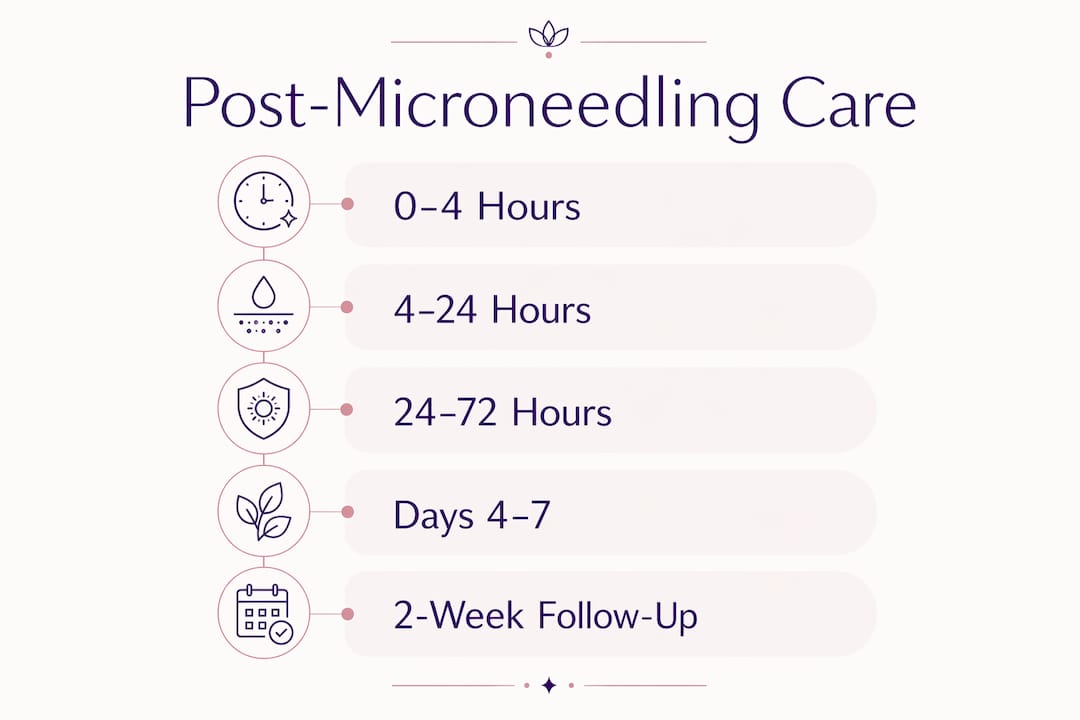
| Phase | Key Actions | What to Avoid |
|---|---|---|
| 0–4 hours | HOCl spray, HA serum, barrier cream, mineral SPF | Washing, touching, all actives |
| 4–24 hours | Gentle lukewarm rinse, fragrance-free cleanser, reapply barrier cream | Makeup, retinoids, acids, exercise |
| 24–72 hours | Continue barrier cream + HA serum, mineral SPF 30+ every 2–3 hours outdoors | Pools, sauna, sweat, alcohol toners |
| Days 4–7 | Reintroduce vitamin C (if skin is calm), light makeup by day 5 | Retinoids until day 7+, peels, laser |
| Day 7+ | Resume normal routine; schedule next session at 4–6 weeks, as typical microneedling series are spaced 4–6 weeks apart to optimize collagen remodeling and minimize risks. | Invasive procedures for several weeks |
0–4 hours. Whatever the clinic applied stays on. If you used a HOCl spray intra-procedure, it continues working as a gentle antimicrobial while channels are open. Document every product applied, including lot numbers.
4–24 hours. The first cleanse matters. Lukewarm water and a fragrance-free cleanser only, no washcloth, no scrubbing. Follow with a medium-weight HA serum and a ceramide-rich barrier cream. Nothing else.
24–72 hours. This is the window where most patients get into trouble. They feel better and reach for their usual routine. Remind them: the micro-channels remain open and hyper-permeable for up to 72 hours. Mineral SPF 30+ is mandatory every time they go outdoors. Change the pillowcase daily for 3–5 days to reduce bacterial load on open channels.
Days 4–7. Vitamin C can typically be reintroduced after 48–72 hours if the formulation is gentle (ascorbyl glucoside or sodium ascorbyl phosphate rather than straight L-ascorbic acid). Retinoids should be delayed until at least day 7 for standard treatments, and longer for more aggressive sessions. Mineral-tinted coverage can be used by day 5 if the skin appears fully calm.
Pro Tip:Book the patient’s 2-week follow-up before they leave the treatment room. Patients who leave without a scheduled appointment rarely call to book one.
What to Use After Microneedling: Ingredients and What to Skip
Safe from day 0
- Hypochlorous acid (HOCl) spray: non-irritating antimicrobial, calms inflammation immediately post-procedure.
- Medium-weight hyaluronic acid serum: hydrates without occluding; safe and recommended from the first application.
- Ceramide/panthenol barrier creams: restore lipid barrier; clinical-grade formulations without fragrance or essential oils are ideal.
- Mineral SPF (zinc oxide or titanium dioxide): sits on the surface rather than penetrating open channels, avoiding the stinging and contact dermatitis risk that chemical filters carry during early recovery.
Avoid for 48–72 hours minimum
| Ingredient class | Why to wait | When to reintroduce |
|---|---|---|
| L-ascorbic acid (vitamin C) | High acidity irritates open channels | 48–72h; switch to stable derivatives first |
| Retinoids | Accelerate cell turnover, disrupt remodeling | Day 7+ (standard depth); longer for aggressive passes |
| AHAs/BHAs | Exfoliants worsen barrier disruption | Day 5–7 minimum |
| Benzoyl peroxide | Oxidative stress on compromised skin | Day 7+ |
| Alcohol-based toners | Strip residual barrier lipids | Avoid for full first week |
| Fragrances/essential oils | Delayed hypersensitivity risk is elevated during hyper-permeability | Avoid indefinitely post-procedure |
Pro Tip:Before any patient with a history of contact dermatitis or rosacea undergoes microneedling, patch-test your planned post-procedure serum on the inner arm 48 hours prior. The hyper-permeable state amplifies sensitization risk.
Infection prevention and recognizing complications early
Clinic sterility checklist
- Single-use, sterile needle heads only. Dispose in a sharps container immediately after each patient.
- Disinfect treatment surfaces between every patient.
- Change gloves before applying any post-procedure topical.
- Document device model, head lot number, and needle depth in the patient record.
Patient instructions to minimize infection risk
- Do not touch the treated area with unwashed hands for the first 24 hours.
- Change pillowcases daily for the first 3–5 days to help prevent infection while channels are open.
- Avoid pools, hot tubs, saunas, and heavy sweating until channels close (72 hours minimum).
- Wash hands before applying any homecare product.
- Do not share towels or face cloths during the recovery period.
Pro Tip:Practitioners report that hygiene steps, particularly single-use heads and fresh pillowcases, account for the majority of preventable post-procedure infections. Put both on the discharge card as explicit written instructions, not verbal reminders.
When to escalate: If a patient reports increasing warmth, pain, or purulence beyond 72 hours, fever above 100.4°F (38°C), new hives, or unexpected pigmentation changes, instruct them to contact the clinic immediately. First-line response: topical antiseptic, clinical assessment within 24 hours. If purulence is present or fever persists, culture the site and refer to a dermatologist or urgent care. Do not wait.
Clinic supplies and homecare kit contents
| Item | Clinical purpose | Notes |
|---|---|---|
| Single-use sterile needle heads | Prevent cross-contamination | Dispose in sharps bin; never reuse |
| HOCl spray | Immediate antimicrobial, anti-inflammatory | Multi-use bottle; patient takes travel size home |
| Medium-weight HA serum (clinical-grade) | Hydration, channel support | Fragrance-free; check pH 6–7 |
| Ceramide/panthenol barrier cream | Lipid barrier repair | Fragrance-free, non-comedogenic |
| Mineral SPF 30+ (zinc oxide/titanium dioxide) | UV protection, PIH prevention | Travel-size for homecare kit |
| Sterile gauze | Blot pinpoint bleeding | Single-use |
| Sterile gloves | Practitioner hand protection | Change between patients |
| Printed patient handout + contact card | Discharge instructions | Laminate clinic copy; print patient copy |
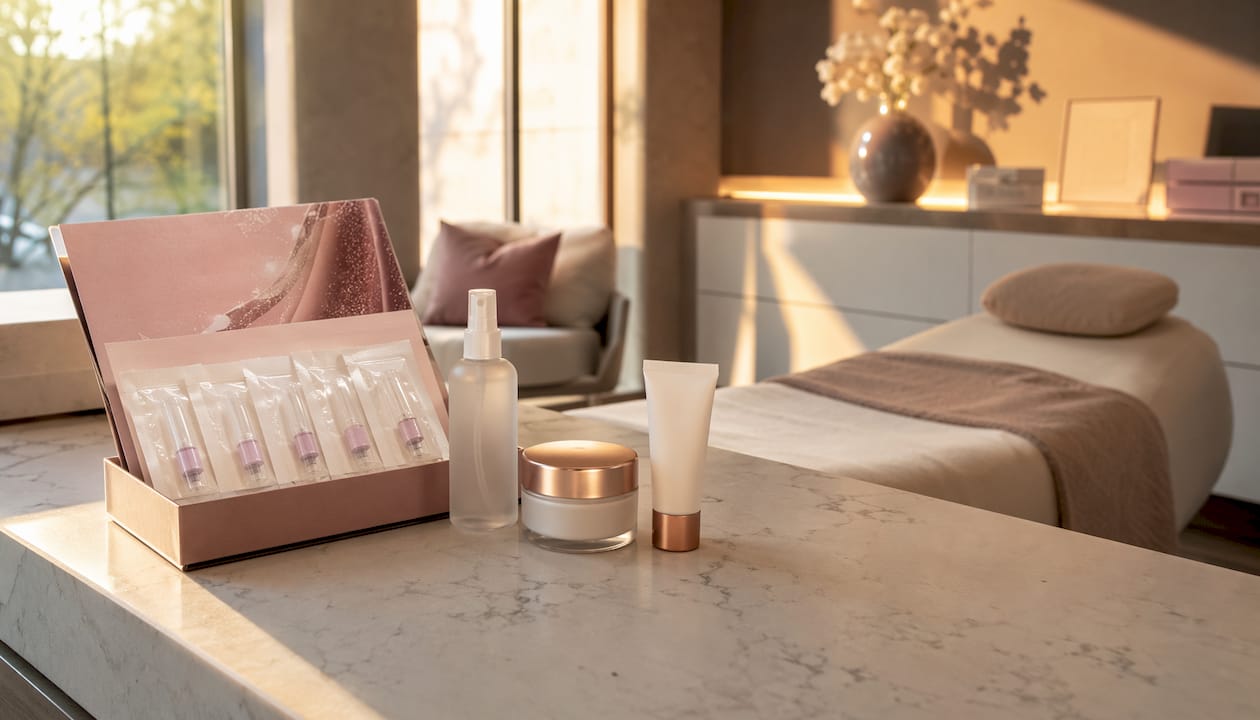
Homecare kit to sell or provide at discharge: HOCl travel spray, HA serum sample, barrier cream sample, mineral SPF travel-size, printed handout, and clinic contact card.
Pro Tip:Specify “clinical-grade” or “medical-grade” on procurement orders and verify that formulations carry minimal ingredient lists with no added fragrance, essential oils, or colorants. A short ingredient list is a quality signal, not a limitation.
Documentation and follow-up schedule
Minimum record fields for every microneedling session:
- Patient ID and consent confirmation date.
- Device model and needle head lot number.
- Needle depth, speed setting, and number of passes per zone.
- Topical products applied in-clinic (name and lot number).
- Homecare list handed to patient (attach a copy to the record).
- Next appointment date confirmed before patient leaves.
Follow-up cadence:
- 24–72 hour check-in (phone or secure message): “How is your skin feeling? Any redness, pain, or swelling beyond what we discussed? Any signs of infection?” Document the response.
- 2-week in-clinic or telehealth review: Assess healing, photograph outcomes, address any lingering sensitivity.
- 4–6 week next-session planning: Standard series spacing is 4–6 weeks depending on goals and skin response.
24–72 hour messaging script:“Hi [Name], this is [Clinic] checking in after your microneedling session. How is your skin feeling? Any unexpected redness, pain, or discharge? Reply here or call us at [number] if anything concerns you. Your 2-week review is booked for [date].”
Pro Tip:Paste the documentation fields above directly into your EHR template. Consistent records protect the clinic and make outcome tracking across a treatment series straightforward.
Why “less is more” is the right call: the clinical rationale
The core principle: Microneedling creates micro-channels that keep the skin hyper-permeable for up to 72 hours. During this window, barrier repair and controlled hydration reduce inflammation and lower hyperpigmentation risk. Introducing actives too early undermines collagen remodeling and increases the chance of adverse reactions.
The 72-hour barrier-repair priority is the single most important concept to communicate to patients. Most want to “boost” results immediately. The evidence says the opposite: a simplified routine during the hyper-permeable window produces better outcomes than an aggressive one.
UV exposure is the other major variable. Mineral SPF 30+ applied daily for at least two weeks is the highest-impact single habit for preventing post-inflammatory hyperpigmentation, particularly in Fitzpatrick types IV–VI. Chemical sunscreen filters should be avoided during early recovery because they can penetrate open channels and cause stinging or contact dermatitis.
Key references for patient education and protocol defense:
- Healthline: microneedling aftercare and healing stages, including fever thresholds and infection signs.
- Byrdie (dermatologist panel): day-by-day product guidance and activity restrictions.
- Express Med Spa (NP guide): SPF protocol, pillowcase hygiene, and PIH prevention.
- House of Aetheria: 72-hour permeability window and mineral SPF rationale.
- Chelsea and Westminster Hospital NHS Foundation Trust: post-treatment patient leaflet covering activity restrictions and swelling management.
- HonestSkinScience: clinical-grade ingredient selection and fragrance/essential oil risk during hyper-permeability.
Key Takeaways
A complete microneedling aftercare protocol requires barrier repair and hydration for the first 72 hours, strict mineral SPF 30+ for at least two weeks, and documented follow-up at 24–72 hours and at two weeks post-procedure is recommended to ensure proper healing and plan further sessions.
| Point | Details |
|---|---|
| 72-hour barrier window | Prioritize HA serum and ceramide barrier cream; delay all actives until channels close. |
| Mineral SPF 30+ is mandatory | Apply daily for two weeks; mineral filters prevent PIH without penetrating open channels. |
| Hygiene prevents most infections | Single-use heads and daily pillowcase changes account for the majority of preventable post-procedure infections. |
| Document every session | Record device model, lot number, needle depth, and in-clinic products applied before the patient leaves. |
| Pandoraaestheticsupply for procurement | Source clinical-grade microneedling pens, single-use heads, and post-procedure consumables from Pandoraaestheticsupply. |
The detail that separates good protocols from great ones
The aftercare handout is where most clinics underinvest. They spend thousands on a device and hand patients a generic printout with no contact number, no red-flag list, and no follow-up date. That gap is where complications go undetected and where patients lose confidence in the clinic, not the treatment.
Two things I’d push every practitioner to do: book the 2-week follow-up before the patient stands up from the chair, and personalize the handout for special populations. Pregnant patients and those with autoimmune conditions need a modified protocol, and “check with your doctor” is not a protocol. Know your contraindications before the appointment, not after. Patients on immunosuppressants, those with active skin infections, or those with a history of keloid scarring need individual assessment, not a standard handout.
The homecare kit is also an underused tool. A small HOCl spray, a barrier cream sample, and a mineral SPF travel-size cost very little to include at discharge and dramatically improve compliance. Patients who leave with the right products in hand use them. Patients who leave with a list of products to buy often don’t.
Stock your clinic with the right consumables from day one
Clinicians who follow a tight aftercare protocol need supplies that match. Pandoraaestheticsupply stocks the professional-grade microneedling pens and systems U.S. clinics rely on, including the Dr. Pen A6, A10, and E30 cordless models, alongside single-use sterile needle heads and the post-procedure consumables that belong in every discharge kit.

The procurement priority for any clinic starting or scaling a microneedling program: single-use heads first, then a clinical HA serum and fragrance-free barrier cream, then mineral SPF. Everything on that list is available through Pandoraaestheticsupply. Browse the full device collection, compare pen models by depth range and speed settings, and order replacement cartridges in the same place. No hunting across multiple vendors.
Authoritative sources and further reading
- Healthline: Microneedling Aftercare — Covers healing stages, infection signs (including the 100.4°F fever threshold), and product categories to use or avoid. Useful for patient education handouts.
- Byrdie: Can You Wash Your Face After Microneedling? — Dermatologist panel; day-by-day activity and product guidance with named physician sources.
- Express Med Spa: Microneedling Aftercare Day-by-Day NP Guide — SPF protocol, PIH prevention, and pillowcase hygiene instructions from a nurse practitioner perspective.
- House of Aetheria: The 72-Hour Window — Clearest available explanation of the hyper-permeability window and mineral SPF rationale.
- Chelsea and Westminster Hospital NHS Foundation Trust: Microneedling Post-Treatment Information — Hospital-grade patient leaflet; useful as a reference standard for activity restrictions and swelling management.
- HonestSkinScience: Best Microneedling Aftercare Products — Clinical-grade ingredient selection, HOCl rationale, and fragrance/essential oil risk during hyper-permeability.
- Pandoraaestheticsupply: Professional Microneedling Devices and Consumables — Procurement reference for single-use heads, clinical serums, and microneedling pens for U.S. clinics.
Disclaimer: This article is general clinical information, not medical or legal advice. Confirm current guidelines with a licensed dermatologist or the relevant U.S. regulatory body for your specific patient population and practice setting.
Microneedling Aftercare Protocol for Clinicians